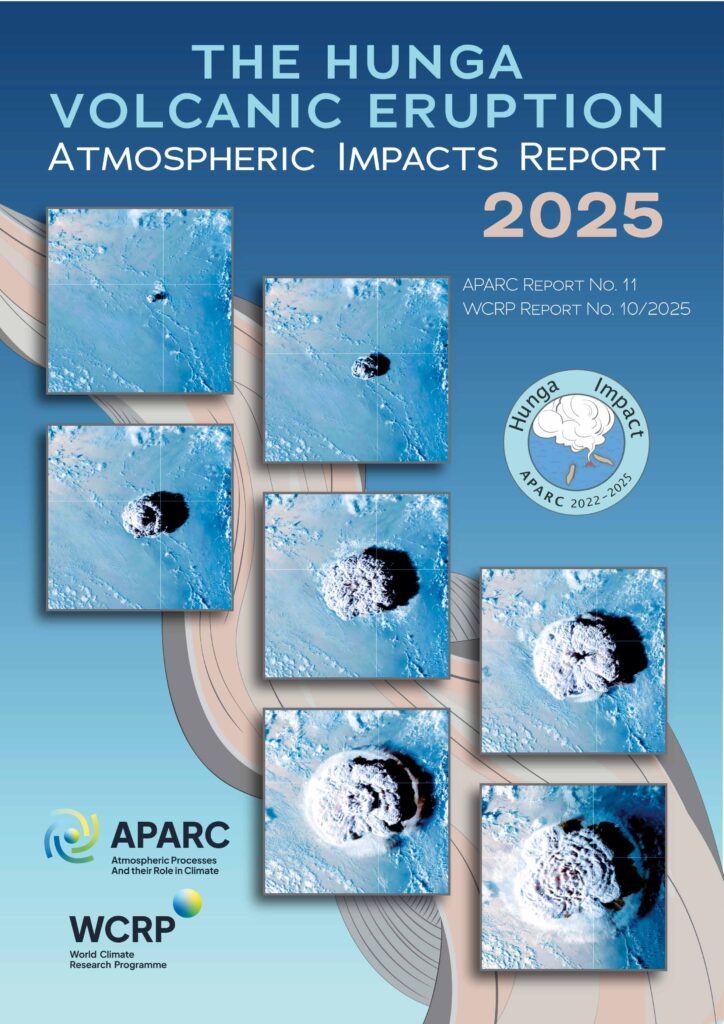
APARC Report No. 11
APARC Report No. 11 (2025)
The Hunga Volcanic Eruption Atmospheric Impacts Report
Prepared by the APARC activity HTHH – Hunga Tonga-Hunga Ha’apai stratospheric impacts, edited by Yunqian Zhu, Graham Mann, Paul A. Newman, and William Randel.
WCRP Report 10/2025
APARC Report No. 11
Citation:
APARC, 2025: The Hunga Volcanic Eruption Atmospheric Impacts Report. Yunqian Zhu, Graham Mann, Paul A. Newman, and William Randel (Eds.), APARC Report No. 11, WCRP-10/2025, doi: 10.34734/FZJ-2025-05237, available at www.aparc-climate.org/publications/
FULL REPORT
Full Hunga Report (70 MB)
Front Matter:
Cover
Permeable and list of autors
Table of content
Acknowledgements
Table of content
Highlights
Executive Summary
Preface
Chapter 01: Volcanological context of the 2022 Hunga eruption
Lead: Simon Carn and Anja Schmidt
1.1 Introduction to submarine volcanism and Hunga volcano
1.2 The 2022 Hunga eruption
1.3 The 2022 Hunga eruption in the context of other historc eruptions
1.4 Summary and conclusions
Chapter 02: The 2022 Hunga plume – first month post-eruption
Lead: Elizabeth Asher and Bernard Legras
2.1 Initial eruption sequence
2.2 Volcano-generated gravity waves (and Lamb waves)
2.3 Water vapour injection
2.4 Plume altitude and dispersion during the first month
2.5 Rapid formation of sulfate aerosol layer
2.6 Microphysical and optical aerosol properties
2.7 Other plume chemical composition: minor injections of gas phase compounds and primary aerosols
Chapter 03: Atmospheric transport and evolution of Hunga water vapour and aerosols
Lead: Sergey Khaykin and Adam Bourassa
3.1 Meridional dispersion of water vapour and aerosol
3.2 Evolution of sulfate aerosols
3.3 Transport of volcanic material into the polar regions
3.4 Uncertainty of observations
3.5 Modelling of the Hunga plume evolution
Chapter 04: Hunga effects on stratospheric temperatures and circulation
Lead: Xinyue Wang and Lawrence Coy
4.1 The large-scale evolution of the Hunga H2O cloud
4.2 Stratospheric transport, temperatures and zonal winds
4.3 Residual mean meridional circulation and Eliassen-Palm flux
4.4 Interaction of Hunga with the Quasi-Biennial Oscillation (QBO)
4.5 Summary
Chapter 05: Effects of the Hunga eruption on stratospheric ozone and related trace gases
Lead: Freja F. Østerstrøm and Michelle L. Santee
5.1 Overview of Hunga effects on total column ozone
5.2 Initial chemical processing and ozone loss in the fresh plume
5.3 Longer-term impacts on stratospheric composition
5.4 Predictions of the future impacts on the stratospheric ozone layer
Chapter 06: Upper stratosphere to thermosphere effects and H2O transport in the deep Brewer-Dobson branch
Lead: Corwin Wright and Jia Yue
6.1 Introduction
6.2 Short-term dynamical impacts on the middle atmosphere
6.3 Impacts on the ionosphere
6.4 Water vapour transport in the middle and upper atmosphere
6.5 Modelling of long-term middle-atmospheric impacts
6.6 Summary
Chapter 07: Radiative forcing and climate impacts caused by the 2022 Hunga volcano eruption
Lead: Georgiy Stenchikov and Mark R. Schoeberl
7.1 Mechanisms of volcanic climate impacts
7.2 Hunga’s radiative forcing agents
7.3 Hunga’s radiative forcing
7.4 Hunga’s climate impact
7.5 Discussion and conclusions
Supplement 1: Hunga Tonga-Hunga Ha’apai volcano impact Model Observation Comparison (HTHH-MOC) project: experiment protocol and model descriptions
Supplement 2: Hunga impacts report observational data supplement
Supplement 3: HTHH-MOC model validation and analysis results
Supplement 4: Other chapter supplementaries
Supplement 5: Hunga Tonga-Hunga Ha’apai Volcano Model Intercomparison Project (Tonga- MIP): Experiment Protocol, Model Descriptions, and Result Preview