
HTHH – Hunga Tonga-Hunga Ha’apai stratospheric impacts
Coordinating Experts Driving the Project
Activity Leads
Yunqian Zhu
LASP & CIRES/NOAA, USA
yunqian.zhu@colorado.edu
Graham Mann
University of Leeds
g.w.mann@leeds.ac.uk
Paul A. Newman
NASA Goddard, USA
paul.a.newman@nasa.gov
William Randel
NCAR, USA
randel@ucar.edu

Overview of the Project’s Objectives and Scope
Activity Description
This HTHH community assessment spans multiple research topics but is focused on the following three science themes:
A. Plume evolution, dispersion and large-scale transport
B. Impacts on stratospheric aerosols and the ozone layer
C. Radiative forcings from the eruption and surface climate impacts.
In 2022, SPARC established a new activity to examine impacts of the Hunga Tonga–Hunga Ha’apai (HTHH) eruption of January 2022. HTHH was the
most explosive volcanic eruption in the satellite era, and the water-rich plume presents an opportunity to understand the impacts on the stratosphere of a large magnitude explosive phreatomagmatic eruption. The wide range of satellite observations of the early stratospheric plume and its global dispersion will provide measurements to evaluate a range of models for their capabilities to represent stratospheric chemistry, aerosol and dynamics, in this case where both water vapor and aerosol are influencing radiative balances and stratospheric ozone.
There are numerous HTHH eruption observational and modeling studies that have been published, preprints of submitted papers, and new research in early stages. As the dispersed volcanic cloud continues to evolve and its impacts emerge, additional papers will be published. Because of the
number and broad range of studies of the HTHH emissions and impacts, a SPARC limited-term cross-activity focused project is being organized to provide a forum for community discussions and synthesis, and to coordinate multi-model assessments. During this 3-year HTHH SPARC activity, the team will co-ordinate research activities and aim to write a special Hunga-Tonga impacts report for publication in late-2025. The report
will directly feed into the upcoming 2026 UNEP/WMO Scientific Assessment of Ozone Depletion report, providing a benchmark synthesis of the impacts from the eruption. Interested scientists in the broader research community are welcomed to be involved in this activity
Plans
- 2022
Nov: HTHH activity begun - 2023
Jan: Outline 1st circulated for comments
May: 1st On-line open meeting
Jun: Model simulations specified
Jun: Outline 2nd draft completed
Aug: Recruit chapter lead authors
Dec: AGU special session on HTHH (side meeting with chapter leads) - 2024
Feb: Model simulations complete, output submitted & begin analysis
Feb: Chapter authors selected by chapter leads finalized
May: Model analysis completed
Jun: In-person open meeting
Jul: Outline 3rd order draft finalized by chapter authors
Sep: 1st draft completed & sent out for external review
Nov: Reviews due, revisions begin - 2025
Feb: 2nd draft completed & reviewed by Editors and chapter Leads
May: 3rd draft completed
Jul: Writing of the Executive Summary, revisions added to 3rd draft
Sep: Final chapter submission
Dec: Report Delivered
The final HTHH APARC Report:
Initial chapters will document the stratosphere aerosol and ozone layer impacts in 2022, and analyze Antarctic ozone hole impacts expected also in 2023 and 2024, along
with water vapor impacts via the upper atmosphere likely to continue into 2024 and 2025.
This HTHH community assessment spans multiple research topics but is focused on the following two science themes:
A) Plume evolution, dispersion and large-scale transport;
B) Impacts on and feedback from the earth system.
Potential chapters include:
- Initial plume dispersion (first week); Evolution of the volcanic cloud and its meridional dispersion;
- HTHH effects on atratospheric temperatures, dynamics, and transport;
- HTHH effects on ozone and stratospheric chemistry;
- Upper stratosphere to mesosphere effects & H2O transport in the deep Brewer-Dobson circulation branch;
- and the radiative and surface/tropospheric climate impacts of the eruption.
Key Insights from Research Outcomes
Published Results
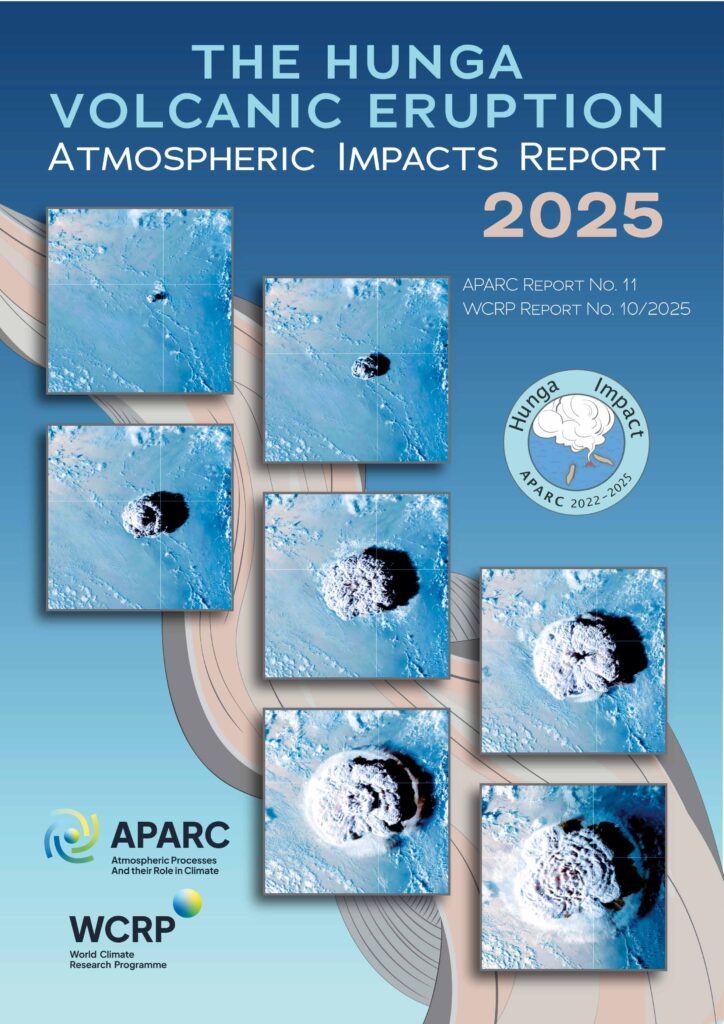
The Hunga Volcanic Eruption Atmospheric Impacts Report (2025)
APARC, 2025: The Hunga Volcanic Eruption Atmospheric Impacts Report. Yunqian Zhu, Graham Mann, Paul A. Newman, and William Randel (Eds.), APARC Report No. 11, WCRP-10/2025, doi: 10.34734/FZJ-2025-05237, available at www.aparc-climate.org/publications/
Peer-Reviewed Contributions to Climate Science
Journal Publications
Zhu, Y., H. Akiyoshi, V. Aquila, E. Asher, E.M. Bednarz, S. Bekki, C. Brühl, A.H. Butler, P. Case, S. Chabrillat, G. Chiodo, M. Clyne, P.R. Colarco, S. Dhomse, L. Falletti, E. Fleming, B. Johnson, A. Jörimann, M. Kovilakam, G. Koren, A. Kuchar, N. Lebas, Q. Liang, C.-C. Liu, G. Mann, M. Manyin, M. Marchand, O. Morgenstern, P. Newman, L.D. Oman, F.F. Østerstrøm, Y. Peng, D. Plummer, I. Quaglia, W. Randel, S. Rémy, T. Sekiya, S. Steenrod, T. Sukhodolov, S. Tilmes, K. Tsigaridis, R. Ueyama, D. Visioni, X. Wang, S. Watanabe, Y. Yamashita, P. Yu, W. Yu, J. Zhang, and Z. Zhuo, Hunga Tonga-Hunga Ha’apai volcano impact Model Observation Comparison (HTHH-MOC) project: Experiment protocol and model descriptions, Geophysical Model Development, doi:10.5194/gmd-18-5487-2025, 2025.

Be Part of the Solution
Join the Climate Conversation
Collaborate with leading experts, explore groundbreaking research, and contribute to shaping a sustainable future. Together, we can make a difference.

Latest Developments and Ongoing Efforts
APARC & SPARC Activity Updates
APARC Newsletter No. 66, 2026, pp. 26-27: The Assessment Report on Hunga Volcano Atmospheric Impacts – Produced by the Hunga Science Team and the APARC Hunga Impact Activity (2022-2025), by Y. Zhu, G. Mann, P. A. Newman, and W. Randel.
APARC Newsletter No. 63, 2024, pp. 14-18: 2nd International Workshop on The Atmospheric Impacts of the 2022 Hunga Eruption, by G. Mann, B. Legras, Y. Zhu, W. Randel and P. A. Newman.
SPARC Newsletter No. 60, 2023, pp. 10-11: Announcement of a new SPARC Hunga-Tonga stratospheric impacts activity, by Y. Zhu, G. Mann, P. A. Newman, B. Randel.
Explore Detailed Resources and Updates
Website for Further Information
For a more comprehensive look into the project, its activities, and its ongoing contributions to atmospheric and climate science, visit the dedicated HTHH website at csl.noaa.gov/assessments/hthh/. Explore the site to stay informed and engaged with the project’s progress and achievements.