
Meetings
Join Us for Our Next Meeting
Upcoming Event
Don’t miss our upcoming event, where experts and researchers will gather to discuss the latest advancements in atmospheric and climate science. Stay connected, share ideas, and be part of the conversation shaping the future.
QBOi – SNAP – QUOCA (QSQ) joint workshop
Name: QBOi – SNAP – QUOCA (QSQ) joint workshop
When?: 24-28 March 2025
Where?: Cambridge, UK
Short Info: Improved simulations of the stratosphere for better predictions of
weather, climate and extreme events
Improved simulations of the stratosphere for better predictions of
weather, climate and extreme events
A joint QBOi – SNAP – QUOCA (QSQ) workshop
24-28 March 2025, Cambridge, UK
The workshop’s purpose will be to facilitate the sharing and discussion of the latest results on the role of the stratosphere in models relevant for enhancing predictability on all timescales. The workshop will serve as the in-person kick-off for the new QUOCA (QUasi-biennial oscillation and Ozone Chemistry interactions in the Atmosphere) joint QBOi-CCMI project. The aim of the workshop is to better understand stratospheric processes and variability, uncertainties, and their influence on surface climate and predictability. For more information, please see the workshop website:
https://sites.google.com/view/qsq-workshop-mar-2025/home
Workshop enquiries should be directed to: qsqworkshop2025@googlegroups.com
QBOi – SNAP – QUOCA (QSQ) joint workshop
Name: QBOi – SNAP – QUOCA (QSQ) joint workshop
When?: 24-28 March 2025
Where?: Cambridge, UK
Short Info: Improved simulations of the stratosphere for better predictions of
weather, climate and extreme events
Improved simulations of the stratosphere for better predictions of
weather, climate and extreme events
A joint QBOi – SNAP – QUOCA (QSQ) workshop
24-28 March 2025, Cambridge, UK
The workshop’s purpose will be to facilitate the sharing and discussion of the latest results on the role of the stratosphere in models relevant for enhancing predictability on all timescales. The workshop will serve as the in-person kick-off for the new QUOCA (QUasi-biennial oscillation and Ozone Chemistry interactions in the Atmosphere) joint QBOi-CCMI project. The aim of the workshop is to better understand stratospheric processes and variability, uncertainties, and their influence on surface climate and predictability. For more information, please see the workshop website:
https://sites.google.com/view/qsq-workshop-mar-2025/home
Workshop enquiries should be directed to: qsqworkshop2025@googlegroups.com

Be Part of the Solution
Join the Climate Conversation
Collaborate with leading experts, explore groundbreaking research, and contribute to shaping a sustainable future. Together, we can make a difference.
A Look Back at Key Discussions
Past Events
Explore highlights and outcomes from our past events, where scientists worldwide collaborated to advance climate research and address pressing questions in atmospheric science.
33rd APARC SSG Meeting 2024
28 – 30 October 2024
Forschungszentrum Jülich, Germany
General Information
The next APARC SSG meeting will be held at the Forschungszentrum Jülich from 28 to 30 October 2024. Unfortunately, Jülich is a small town with a limited number of hotels and leisure activities and is difficult to reach by public transportation. That’s why we decided to ask you to book your hotel in Aachen. Aachen is well connected by train to several nearby airports. Düsseldorf, Cologne, Brussels and Frankfurt are possible destinations. We will arrange daily bus transfers from Aachen to Jülich in the morning and from Jülich to Aachen in the evening. We also plan to have a common dinner together in Aachen on Tuesday evening. In addition, Aachen has an old city center with a beautiful cathedral, many restaurants, and is always worth a visit if you have some free time.
We will hold this meeting as a hybrid meeting. If you are unable to travel, you will have the opportunity to participate online.
Meeting Agenda
The SSG meeting will start on October 28 at 09:30 CET and will end at October 30, 13:00 CET, follwed by a closed SSG session in the afternoon.
Please have a look at our final Meeting Agenda.
Travel information
Venue of the meeting
Forschungszentrum Jülich
Wilhelm-Johnen-Straße
52428 Jülich
Germany
Details about Aachen
Aachen is easy to reach by train from all major airports in the area. Average journey times by train (depending on the connection) are:
- DUS – Aachen: 1:30 h
- CGN – Aachen: 1:15 h
- BRU – Aachen: 1:30 h
- FRA – Aachen: 2:15 h
A bus shuttle will be organized for transportation between Aachen and Forschungszentrum Jülich. The starting point of the shuttle bus will be Sandkaulstraße in Aachen.
In case the departure times of the shuttle do not fit your personal travel plans, you have the possibility to take a public bus:
https://avv.de/files/avv/files/fahrplaene/linienfahrplaene/sb20_avv.pdf
Additionally, we will organize a transfer from the Forschungszentrum Jülich to the Düsseldorf airport (DUS) on Wednesday afternoon at 2 PM and 5 PM on request. Please let us know your requirements by 04 October 2024 latest. Requests made after 04 October 2024 cannot be guaranteed.
Recommended hotels in Aachen
INNSiDE Aachen
https://www.melia.com/en/hotels/germany/aachen/innside-aachen
Ca. 140 EUR / night incl. breakfast
Distances: Located directly at the stop for the bus shuttle, 650 m walking distance to the cathedral in the center of the old town
B&B HOTEL Aachen-City
https://www.hotel-bb.com/en/hotel/aachen-city
Ca. 90 EUR / night incl. breakfast
Distances: 200 m walking distance to the bus shuttle, 450 m walking distance to the cathedral in the center of the old town
Of course, there are many more hotels within walking distance to the bus stop and the old town e.g.,
- AQUIS Grana (https://www.hotel-aquis-grana.de/en/)
- Motel One (https://www.motel-one.com/en/hotels/aachen/hotel-aachen/)
… and many more. Choose the hotel you like best!
Visa requirements
Visa requirements to enter Germany vary greatly between nationalities and it is therefore essential to check visa requirements before travelling. Visas must be obtained prior to arrival in the country and it is the responsibility of each participant to obtain the required entry visa to Germany. Please note that a Schengen visa is required, even for transiting through Schengen-zone European countries.
Please find information on Visa requirements and applications at:
Federal Republic of Germany – Federal Foreign Office (auswaertiges-amt.de)
Local Information
Timezone
Juelich time zone is Central European Time (CET), which is UTC+1 in October.
31st SPARC SSG Meeting 2023
17 – 19 July 2023
DLR, Oberpfaffenhofen, Germany
Meeting Agenda
The meeting agenda as of 18 July 2023:
Day three: Wednesday, 19 July
09:00 Welcome
09:10 SPARC: new structure implementation
. Activity Collaboration Groups (20 min discussion each)
. Advisory/Coordination Panels (20 min discussion each)
11:25 Coffee break
11:40 New SPARC Science
. VSLS activity proposal
. New LTCF: Large-Ensemble Single-Forcing MIP
12:45 Lunch break
13:45 SPARC Business
. Office update (incl. Budget update, travel options, future SPARC meetings)
. re-branding
14:15 Brainstorming Session
14:45 Wrap-up
14:50 Coffee break
15:00 SSG closed Session (approx. 1 hour)
Day two: Tuesday, 18 July
09:00 Welcome
09:10 WCRP Lighthouses
. Safe Landing Climates
. My Climate Risk
. Explaining and Predicting Earth System Changes
. Digital Earths
10:25 Coffee break
10:45 Partner Projects
. CliC
. ESMO
. RiFS
. GAW
12:00 Lunch break
13:00 Guided Tour: DLR Flight Operations (including HALO aircraft)
14:00 Guided Tour: German Space Operations Center (GSOC)
15:00 Partner projects (continued)
. IGAC
. CLIVAR
. GEWEX
. GPEX
. Climate intervention
16:15 Coffee break
16:35 Space Agencies
. ESA
. NASA
. CSA
17:35 Discussion & Wrap-up
19:00: Meeting Dinner
Day one: Monday, 17 July
09:00 Welcome Session
. Welcome, Goals, and Agenda
. SPARC@DLR
10:00 WCRP update
10:30 LTCF: Hunga Tonga stratospheric impacts
11:00 Coffee break
11:15 Greetings from WCRP chair Detlef Stammer
11:30 Activity updates (15 min each)
. SATIO-TCS, FISAPS
12:15 Lunch break
13:15 Activity updates (15 min each)
. SSiRC, QBOi, DynVar, SNAP, TUNER
15:15 Coffee break
15:25 Activity updates (15 min each)
. OCTAV-UTLS, ACAM, GravityWaves
16:40 Coffee break
16:50 Activity updates (15 min each)
. ATC, CCMi, S-RIP, LOTUS, SOLARIS-HEPPA
18:45 Wrap-up
Registration
CLOSED
The Role of Atmospheric Dynamics for Climate and Extremes
A Joint SPARC DynVar · SNAP Meeting
9-13 October 2023
at the Meteorological Institute at Ludwig-Maximilians-University Munich, Germany
General information
Additional and more up-to-date information can be found at the local organization’s workshop webpage here.
Scientific Program
- Links of atmospheric circulation to weather and climate on subseasonal to centennial timescales
- The role of stratosphere-troposphere coupling in predictability of tropospheric climate and surface weather extremes
- The influence of climate model biases on uncertainty in predictions and projections
- Emerging dynamical constraints to understand and reduce projection uncertainties
- Mechanistic understanding of dynamic coupling, teleconnections, and trends
Keynote speaker:
Paul Kushner, University of Toronto, Canada
Invited speakers:
Christiane Jablonowski (USA),
Marta Abalos (Spain),
Noel Keenlyside (Norway),
Marina Friedel (Switzerland),
Dillon Elsbury (USA),
Tim Woollings (UK),
Peter Hitchcock (USA),
Hera Kim (South Korea),
William Seviour (UK),
Blanca Ayarzagüena (Spain),
Hamid Pahlavan (USA)
Zachary Lawrence (USA)
A tentative program can now be douwnloaded below. All participants should let the organizers know ASAP if you no longer can attend the workshop, or if there is any insurmountable scheduling conflict with your assigned time. This program is not final and may be subject to changes.
Registration
CLOSED
Note that all ECS and everyone receiving travel support (s recently announced in a separate email) is eligible for the reduced registration fee of 150 Euros.
Abstract submission
Abstract submission is closed already.
Travel support opportunities
Travel support for early career scientists and attendees from developing nations can be requested. Please indicate whether you require travel support in the Abstract Submission form (see above)
and send an Email to dynVarSNAP23@gmail.com with the subject “Travel Support: YOUR NAME” by May 15. This email needs to contain the following information:
– estimate of requested budget details
– for PhD students: name and email of PhD supervisor
– short CV as attachment (up to 2 pages, incl. nationality)
Note: travel support application is closed.
Important Dates
Deadlines will be announced in early 2023.
| Abstract submission deadline: | 22 May (closed) |
| Travel support application deadline: | 22 May (closed) |
| Registration deadline: | 31 August |
Location
Ludwig-Maximilans-University Munich, Oettingenstr. 67
(close to English Garden)
Organizing Committee
Alexey Karpechko
Daniela Domeisen
Chaim Garfinkel
Amy Butler
Local Organizing Committee
Thomas Birner
Hella Garny
SPARC Activities Meetings
Here you will find any recordings of past meetings or events organised by SPARC activities. If you have anything you would like to add here, please contact the SPARC project office (office(at)sparc-climate.org).
QBO@60 webinar series
In lieu of the QBO@60 workshop in July 2021, an online seminar took place on 6 July 2021 that featured two invited talks celebrating the discovery of the QBO. The invited speakers were Kevin Hamilton and Mike Wallace.
The recording of the seminar can be found here.
The discovery of the QBO and related developments, 1883-1961
Kevin Hamilton, International Pacific Research Center, University of Hawai`i at Mānoa
In the last months of 1883 a global sensation was spawned by the sudden appearance of spectacular sunrises and sunsets throughout the world (e.g. see Simon Winchester’s 2003 bestseller “Krakatoa – the Day the World Exploded”). The effort to demonstrate the connection between the colorful twilight phenomena and the August 1883 eruption of Krakatau in Indonesia led to the discovery of the first atmospheric jet stream – in this case a very strong easterly jet at roughly 25 km altitude and completely circling the equator. At the time almost nothing else was known about the atmosphere much above ground level. However, the 1890’s saw the beginning of the era of systematic scientific exploration of the atmosphere with unmanned balloons. By 1902 the existence of the stratosphere was established. Scattered balloon observations in the tropics in the ensuing years showed that at times the zonal winds in the equatorial lower stratosphere could feature both layers of easterlies and layers of westerlies. These observations were interpreted as reflecting the presence of a very narrow westerly jet within a broad and robust “Krakatoa easterly” regime. Progress in understanding of the stratospheric circulation was boosted in the 1950’s by the observations taken in support of the extensive nuclear weapons tests conducted in the tropical Pacific. These observations demonstrated that even a zeroth order view of the circulation in the tropical stratosphere must include the interannual reversals of the very strong prevailing zonal winds. In 1961 groups in the US and the UK independently published papers that showed the presence of a quasi-repeatable oscillation of period near two years and that had a characteristic downward phase propagation. This discovery was completely surprising – indeed initially utterly mystifying – and inspired many of the most important developments in dynamical meteorology in the ensuing 6 decades. This talk will review the history through 1961 and highlight the contributions from some now rather forgotten amateur and professional scientists.
Impact of the discovery of the QBO upon research in the subsequent decade
Mike Wallace University of Washington
The period following the discovery of the QBO in 1960, was marked by theoretical advances relating to the propagation of planetary waves on an equatorial beta-plane and their interactions with the zonal mean background flow. Another important development was the identification of vertically propagating planetary waves in the equatorial lower stratosphere. Events during the period 1966-68 followed one another in such quick succession that the time sequence is fuzzy. In terms of this symposium, what’s remarkable is that they culminated in Lindzen and Holton’s theoretical explanation of how the QBO works. Their first paper, published in 1968, describes how vertically propagating gravity waves give up their momentum to the basic state zonal flow in easterly and westerly shear zones, causing them to descend. Though it involved what appeared at the time to be some questionable assumptions about equatorially trapped planetary waves and how they interact with the mean flow, not only has the Lindzen and Holton mechanism endured: its validity is more widely acknowledged now than when it was first proposed. With this history as a backdrop, I will share a few reminiscences of the events that transpired back at that time and a few reflections on what we’ve learned about the QBO and related phenomena in the years since then.
30th SPARC SSG Meeting November 2022
Meeting Agenda
There will be multiple online meetings over two weeks in January 2022.
The first 3 hour meeting on the 08 November 2022 will dedicated to SPARC activity reports and reports from partner projects.
The second 3 hour meeting on the 10 November 2022 is dedicated to the implementation of the new SPARC strategy, with discussions on the new structure, and how to start the transition to a new era for SPARC.
The final 3 hours meeting on the 16 November2022 will be reserved for continued discussions on the SPARC strategy and implementation. There will be the SPARC business updates, and the second part of the meeting will be a closed SSG session to discuss internal issues concerning the SPARC SSG only.
Registration
CLOSED
29th SPARC SSG Meeting January 2022
Meeting Agenda
There will be multiple online meetings over two weeks in January 2022.
The first 3 hour meeting on the 11 January 2022 will dedicated to SPARC activity leaders presenting an update and highlights on their respective activities.
The second 3 hour meeting on the 18 January 2022 is a ‘Cross collaboration discussion session’ where we would like to discuss how the new SPARC strategy fits in with other WCRP core projects and the lighthouse activities.
The final 3 hours meeting on the 21 January 2022 will be dedicated to continued discussions around items raised during the second meeting. The second part of the meeting will be a closed SSG session to discuss internal issues concerning the SPARC SSG only.
Registration
CLOSED
7th SPARC General Assembly
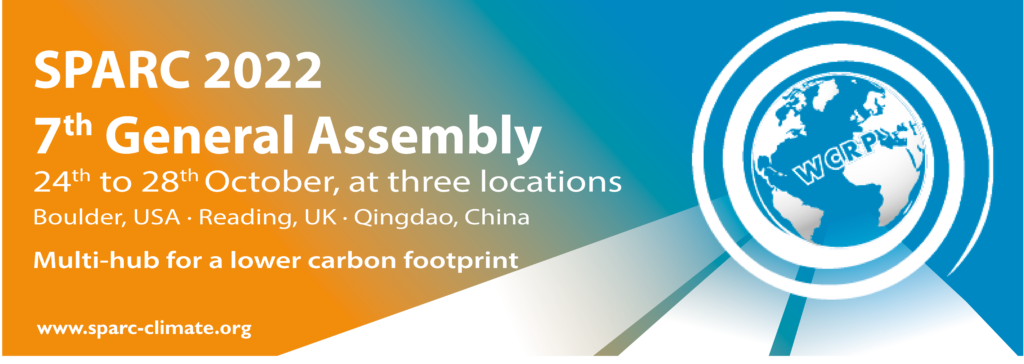
SPARC is holding its 7th General Assembly from 24th to 28th October 2022. The format of the SPARC GA will be different from past GAs, as it will be on a multi-hub basis with three locations (hubs) confirmed at the National Center for Atmospheric Research (NCAR), in Boulder, USA, the European Centre for Medium-Range Weather Forecasts (ECMWF), in Reading, UK, and the First Institute of Oceanography (FIO) in Qingdao, China.
This is a trial of the multi-hub format, designed to retain the face-to-face element and international collaboration while also reducing the carbon footprint of the meeting. While all meeting hubs are open to all participants, we strongly encourage participants to attend the hub that minimizes the carbon cost of their attendance.
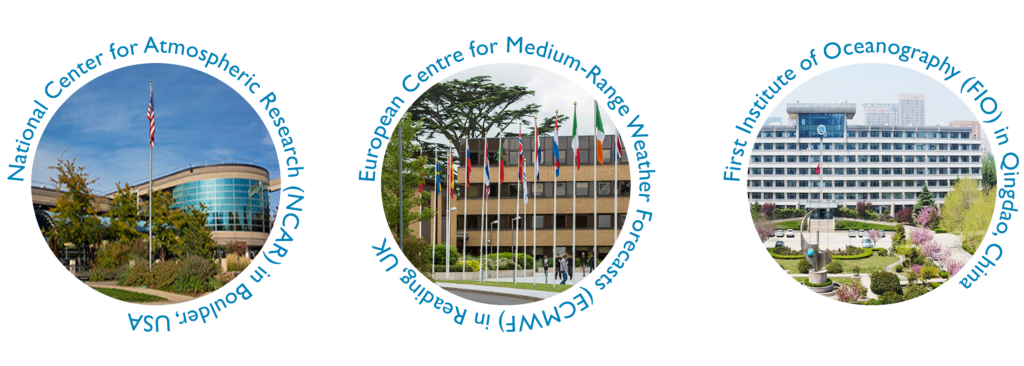
The conference will combine three, linked face-to-face meetings. There will also be the opportunity for participants to attend remotely. We expect between 350 and 400 participants shared between the three hubs, with two hubs taking part in live oral and posters sessions at any one time.
Find out more – please visit the conference website here.
SPARC’s 30th anniversary – webinar series
This year marks the 30th anniversary of the World Climate Research Programme’s SPARC core project. In this time, SPARC has evolved into a major international research coordination hub for atmospheric sciences, with the primary goal to facilitate research that improves our understanding of atmospheric processes and their role in climate. SPARC’s initial focus was on stratospheric science linked to ozone depletion, but has expanded to cover the whole atmosphere including the coupled troposphere-stratosphere system and impacts on surface climate.
SPARC is particularly recognised for its lively scientific community. To celebrate SPARC’s achievements over the last three decades, we have held a series of three webinars leading up to the grand SPARC General Assembly in October 2022.
First SPARC anniversary webinar
When: 21 April 2022 – 13 UTC
Presenter: Prof. Susan Solomon
Flyer for the event here
Recording can be found here.
Our host for the first SPARC 30th anniversary webinar on Thursday 21st April 2022 13 UTC was Prof. Susan Solomon from the Department of Earth, Atmospheric, and Planetary Sciences, Massachusetts Institute of Technology (MIT). She gave a presentation on “Evolving Challenges in Stratospheric Processes and their Role in Climate”, taking us through some history of how our science has experienced a succession of things that have challenged our understanding and how the science community rose to the challenges.
Second SPARC anniversary webinar
When: 13 June 2022 – 13 UTC
Presenter: Prof. Ted Shepherd
Flyer for the event here
Recording can be found here.
Questions that couldn’t be answered during the webinar because of time constrains can be found here.
Our host for the first SPARC 30th anniversary webinar on Monday 13 June 2022 13 UTC was Prof. Ted Shepherd from the University of Reading and he gave a presentation on “Understanding the role of atmospheric
circulation in climate variability and change”.
Third SPARC anniversary webinar
When: 7 October 2022 – 12 UTC
Presenter: Prof. Thomas Peter
Flyer for the event here
Recording can be found here.
Our host for the first SPARC 30th anniversary webinar on Friday 7th October 2022 at 12.00 UTC was Prof. Thomas Peter from the ETH Zürich will give a presentation on “Research on climate intervention by stratospheric aerosol injection (SAI) – should SPARC engage?”
SPARC’s 30th anniversary – webinar series
This year marks the 30th anniversary of the World Climate Research Programme’s SPARC core project. In this time, SPARC has evolved into a major international research coordination hub for atmospheric sciences, with the primary goal to facilitate research that improves our understanding of atmospheric processes and their role in climate. SPARC’s initial focus was on stratospheric science linked to ozone depletion, but has expanded to cover the whole atmosphere including the coupled troposphere-stratosphere system and impacts on surface climate.
SPARC is particularly recognised for its lively scientific community. To celebrate SPARC’s achievements over the last three decades, we have held a series of three webinars leading up to the grand SPARC General Assembly in October 2022.
First SPARC anniversary webinar
When: 21 April 2022 – 13 UTC
Presenter: Prof. Susan Solomon
Flyer for the event here
Recording can be found here.
Our host for the first SPARC 30th anniversary webinar on Thursday 21st April 2022 13 UTC was Prof. Susan Solomon from the Department of Earth, Atmospheric, and Planetary Sciences, Massachusetts Institute of Technology (MIT). She gave a presentation on “Evolving Challenges in Stratospheric Processes and their Role in Climate”, taking us through some history of how our science has experienced a succession of things that have challenged our understanding and how the science community rose to the challenges.
Second SPARC anniversary webinar
When: 13 June 2022 – 13 UTC
Presenter: Prof. Ted Shepherd
Flyer for the event here
Recording can be found here.
Questions that couldn’t be answered during the webinar because of time constrains can be found here.
Our host for the first SPARC 30th anniversary webinar on Monday 13 June 2022 13 UTC was Prof. Ted Shepherd from the University of Reading and he gave a presentation on “Understanding the role of atmospheric
circulation in climate variability and change”.
Third SPARC anniversary webinar
When: 7 October 2022 – 12 UTC
Presenter: Prof. Thomas Peter
Flyer for the event here
Recording can be found here.
Our host for the first SPARC 30th anniversary webinar on Friday 7th October 2022 at 12.00 UTC was Prof. Thomas Peter from the ETH Zürich will give a presentation on “Research on climate intervention by stratospheric aerosol injection (SAI) – should SPARC engage?”
28th SPARC SSG Meeting 2020
28th SPARC SSG meeting
18 Novemember 2020, 12 UTC (SPARC Strategy discussion)
TENTATIVE: 2nd & 9th February 2021 (Activity Reoporting)
online
Meeting Agenda
There will be multiple online meetings this year.
The first meeting is dedicated to discuss the future direction of SPARC, and the input created by the SPARC Strategy Task Team, kindly led by Amanda Maycock.
A second SSG meeting will be dedicated to the reporting by the activities and internal SSG business. The dates and agenda for this second meeting are still to be announced.
Registration
CLOSED
CFC-11 Symposium 25-27 March 2019, Vienna, Austria
+++ NOTE: The Symposium will take place as scheduled for March 25-27. No need to reschedule +++
Purpose:
The Montreal Protocol was designed to protect the stratospheric ozone layer by reducing the abundances of ozone depleting substances (ODS) such as chlorofluorocarbons (CFCs) in the atmosphere. The measures taken were successful with the abundance of ODS peaking in the late 1990s and continuously decreasing since that time. However, in a recent letter to Nature, Montzka et al. (2018) reported an unexpected and persistent global emission increase of 13,000 tonnes of CFC-11, both a powerful ozone-depleting substance and a powerful greenhouse gas. This study combined decade-long time-series of CFC-11 from various continents with a suite of two- and three-dimensional model simulations. It concluded that emissions from eastern Asia had increased, although increases in other regions were not ruled out. It also suggested that the CFC-11 emission increase arises from new production that has not been reported to the Ozone Secretariat of the United Nations Environment Programme.
The purpose of the Symposium is to provide a forum for scientists and technologists to explore and present information on the potential causes of the increased CFC-11 emissions. This information will provide a firmer scientific basis for discussions amongst the Parties of the Montreal Protocol in the coming years. The Symposium is open to discussions on all aspects of CFC-11 and related compounds, from production to atmospheric loss, along with environmental impact of the molecule.
Topics include, but are not exclusive:
• Pathways by which CFC-11 is produced primarily, or inadvertently, along with feedstocks for that production (e.g., CCl4) and co-produced compounds (e.g., CFC-12).
• Feedstock usages of CFC-11
• Primary usages of CFC-11, both historical and current
• Emission sources for CFC-11 and related compounds, their magnitudes, and timescales for CFC-11 release.
• Analysis of compounds that can be used to trace atmospheric transport of CFC-11
• Bottom-up estimates of global and regional CFC-11 emissions
• Atmospheric observations, sampling techniques, and analysis of CFC-11 and related compounds (ground, aircraft, satellite)
• Top-down emission estimates of global and regional CFC-11 emissions
• Lifetime estimates of CFC-11 and CFC-11 loss processes
• Ozone depletion from the increased emissions to date, and projected for the future
• Other environmental impact of the increased emissions, including increases of UV and climate.
Day 1 – Monday, March 25th 2019
| Time | Authors | Title |
| 10:00 | Newman | Greeting & Purpose |
| 10:20 | Montzka | Atmospheric measurements of CFC-11 through 2018: Are global CFC-11 emissions back on the decline? [Password protected PDF] |
| 10:40 | Park | Identifying potential CFC-11 emission sources in China based on atmospheric observations from 2008 to 2016 |
| 11:00 | Break | |
| 11:40 | Western | Estimates of CFC-11 emissions from eastern Asia based on atmospheric measurements and inverse |
| 12:00 | Adcock, Reeves, et al. | The origin of high concentrations of CFC-11 observed in Taiwan |
| 12:20 | Arduini | CFC measurements from Nepal Climate Observatory – Pyramid (Nepal), GAW global station |
| 12:40 | Lunch break | |
| 14:00 | Bennish | Aircraft Measurements of Elevated CFC-11 Concentrations over the North China Plain in Spring 2016 [Password protected PDF] |
| 14:20 | Dang, Guo | Long-term spatiotemporal variations and source changes of halocarbons in the greater Pearl River Delta region, China |
| 14:40 | Fang | Rapid increase in ozone-depleting CHCl3 emissions from eastern China |
| 15:00 | Simpson | Recent CFC-11 enhancements in China, Korea, Saudi Arabia and Pakistan |
| 15:20 | Break | |
| 16:00 | Tope, Campbell, Sleigh | Understanding the production of CFC-11, associated chemicals, and related emissions |
| 16:20 | Walter-Terrinoni | Foam Uses |
| 16:40 | Kuijpers, Clodic, Lord, Polonara | CFC refrigerant banks and emissions 1990-2010-2018 |
| 16:50 | Jose Pons | Aerosol, solvent and other misc uses of CFC-11 and CFC-12 |
| 17:00 | Fahey & Pyle | Day 1 Wrap-up Discussion |
Day 2 – Tuesday March 26th
| Time | Authors | Title |
| 09:00 | Reimann & Simpson | Summary of 1. Asian measurements and modeling |
| 09:20 | Sherry | Production pathways and usages of CFC-11 from carbon tetrachloride |
| 09:40 | Perry | Understanding and Mitigating the Impacts of Illegal CFC-11 Use in the Production of Polyurethane Foams |
| 10:00 | Reimann | Additional CFC-11 emissions: Foam is the only answer, is it? [Password protected PDF] |
| 10:20 | Break | |
| 11:00 | Solomon | Evaluation of Chlorofluorocarbon Banks, Uncertainties, and Implications for Emissions |
| 11:20 | Daniel | A path towards more useful future CFC scenarios |
| 11:40 | Walter-Terrinoni, Theodoridi, Tope, Maranion | Emissions & Hypothetical Release Scenarios |
| 12:00 | Kuijpers, Ashford, Clodie, Lord | Considering total bottom-up emissions and comparisons with top-down numbers |
| 12:20 | Lunch break | |
| 13:40 | Fraser | Chlorofluorocarbon (CFC-11, CFC-12, CFC-113) emissions in Australia: 1962-2017 [Password protected PDF] |
| 14:00 | Manning | Estimating CFC-11 emissions over Western Europe from atmospheric observations |
| 14:20 | Schuck | New Long-term Measurements of CFC-11 and other halocarbons at Taunus Observatory [Password protected PDF] |
| 14:40 | Vollmer | Increasing Emissions of Montreal Protocol Substances Other than CFC-11 [Password protected PDF] |
| 15:00 | Prather | Understanding the role of the stratosphere on the lifetime and surface variability of CFC-11 |
| 15:20 | Break | |
| 16:00 | Reeves & Hu | Summary 2. Bottom-up emissions and Production Processes |
| 16:20 | Laube | Distributions and correlations of CFC-11 and other trace gases in the upper troposphere and stratosphere |
| 16:40 | Portmann | Interannual Stratospheric Transport Variability Impacts on Surface Trace Gas Concentrations |
| 17:00 | Solomon & Safari | Day 2 Wrap-up Discussion |
Day 3 – Wednesday March 27th
| Time | Authors | Title |
| 09:00 | Tope & Maione | Summary of 3. Non-Asian Measurements and modelling [Password protected PDF] |
| 09:20 | Mueller | Stratospheric loss of Stratospheric loss of CFC-11 and age-of-air in the Chemical Lagrangian model of the Stratosphere (CLaMS) |
| 09:40 | Sheese | Recent changes in CFCs in the upper troposphere – lower stratosphere from the ACE-FTS satellite |
| 10:00 | Laeng | On natural atmospheric variability of CFC-11 [Password protected PDF] |
| 10:20 | Break | |
| 11:00 | Park & Daniel | Summary of 4. Interannual variability and transport |
| 11:20 | Keeble | The Impact of Recent East Asian Emissions of CFC-11 on Ozone Recovery |
| 11:40 | Fleming, Newman, et al. | The impact of continuing emissions of CFC-11 on the stratospheric ozone layer |
| 12:00 | Nützel | Implications of constant CFC-11 concentrations for the future ozone layer |
| 12:20 | Lunch break | |
| 13:40 | Liang | GEOSCCM simulations of the Antarctic ozone hole changes due to continuing CFC-11 emissions |
| 14:00 | Chipperfield | Determination of the Sources and Implications of Increased CFC-11 Emissions using Inverse and Forward 3-D modelling |
| 14:20 | Eleftheratos | A note on possible effects of the unexpected increase in global CFC-11 to ozone profiles and erythemal doses at ground level [Password protected PDF] |
| 14:40 | Break | |
| 15:20 | Kurylo & GodinBeekmann | Summary of 5. Ozone Impacts, modeling, and trends |
| 15:40 | Weiss, Jucks, Manning, Chipperfield | Summary on needed observations and research gaps [Password protected PDF] |
| 16:00 | Newman & Harris | Final Discussion and Next Steps |
Attendance Application and Registration:
Registration and abstract submission will provisionally open on October 25, 2018 and close on January 14 2019. More details on the timing and procedure will be announced in the coming weeks. The Symposium is limited to 100 persons. Hence, attendance will be approved by the Scientific Steering Committee if applications are oversubscribed. Priorities on attendance will be based upon (a) whether an applicant has submitted an accepted abstract and (b) their technical and scientific interests and standing.
Limited travel funding will be available for attendance, again subject to priorities outlined above.
Symposium Venue:
Vienna International Centre
United Nations Office at Vienna Wagramerstrasse 5
1400 Vienna
Austria
https://www.unov.org/unov/en/vic.html
Contact:
If you are interested in attending, please email Ms. Susan McFadden (susan.k.mcfadden@nasa.gov), and Symposium notifications will be emailed to you as registration and abstract submissions open.
Geir Braathen (WMO), Neil Harris (SPARC), Paul Newman (SAP), Bella Maranion (TEAP), Sophia Mylona (Ozone Secretariat)
Scientific Programme Committee:
Tina Birmpili (Ozone Secretariat), Geir Braathen (WMO), Neil Harris (SPARC), Jianxin Hu (Univ. Beijing), Ken Jucks (NASA), Paul Newman (SAP), Bella Maranion (TEAP), Steve Montzka (NOAA), Sophia Mylona (Ozone Secretariat), Sun Young Park (Korea), Stefan Reimann (Empa), Matt Rigby (Univ. Bristol), Takuya Saito (Japan), Helen Tope (TEAP)
Registration has closed on January 15 2019, 00:00h.
1) Meeting Venue:
Vienna International Centre
United Nations Office at Vienna
Wagramerstrasse 5
1400 Vienna
Austria
https://www.unov.org/unov/en/vic.html
2) List of Hotels:
A list of recommended hotels located near the meeting venue can be found at the following link:
This is a list of 28 Hotels of various categories. The following four hotels are within 5-20 min walking distance of the venue:
HOTEL MELIA VIENNA
ARCOTEL KAISERWASSER (Arcotel)
PARK INN VIENNA (Radisson)
HOTEL NH DANUBE CITY
Participants are responsible for making their own bookings for hotel accommodation directly with hotels and are advised to do so as soon as possible in order to take advantage of preferred accommodation and because of other events taking place in Vienna at the same time. Participants are advised to request the United Nations rate when making bookings in order to benefit from preferred rates.
3) Visa information:
Visa requirements to enter Austria vary greatly between nationalities and it is therefore essential to check visa requirements before travelling. Visas must be obtained prior to arrival in the country and it is the responsibility of each participant to obtain the required entry visa to Austria. Please note that a Schengen visa is required, even for transiting through Schengen-zone European countries.
4) Health requirements and medical facilities:
Visitors to Austria are required to pay for health services. Participants travelling to Austria are therefore strongly advised to obtain medical insurance before leaving their home country. The Secretariat will not assume responsibility for health-care services for meeting participants in Austria.
No immunizations are required to enter Austria, although participants are advised to make sure that their tetanus, diphtheria and polio vaccinations are up to date before travelling.
First-aid and emergency services will be available at the venue throughout the meeting and a United Nations joint medical services clinic is located at the venue. The closest hospital to the venue is located at the following address:
Vienna General Hospital
(Allgemeines Krankenhaus)
Währinger Gürtel 18-20
1090 Wien
Tel: (+43 1) 40400-01964 or 3954
5) Local transportation and safety:
a) Local transportation
Participants are responsible for making their own arrangements for transportation to and from the airport and their hotels and the Vienna International Centre.
An airport bus service operates between the Vienna International Airport and Morzinplatz (U1/U4 metro station at Schwedenplatz) at a cost of 8 euros for a single journey, including luggage. Journey time is approximately 20 minutes. Buses leave the airport for Morzinplatz at 1.20 a.m. and 2.50 a.m., then every 30 minutes from 4.50 a.m. to 12.20 a.m. Buses leave Morzinplatz for the airport at 12.30 a.m. and 2 a.m., then every 30 minutes from 4 a.m. to 11.30 p.m.
There is also a bus service between the Vienna International Centre (next to the Kaisermühlen/Vienna International Centre station on the U1 metro line) and Vienna International Airport. The fare is 8 euros for a one-way ticket and 13 euros for a return ticket, and the travel time is approximately 20-45 minutes, depending on the time of day of travel. Buses leave the airport for the Vienna International Centre every hour from 7.10 a.m. to 8.10 p.m. and leave the conference centre for the airport every hour from 6.10 a.m. to 7.10 p.m.
The City Airport Train (CAT) transports passengers between the CAT terminal in Vienna (the Wien Mitte/Landstrasse station on U3 and U4 metro lines) and Vienna International Airport. The fare is 12 euros for a one-way ticket and 19 euros for a return ticket, and the travel time is approximately 16 minutes. Trains leave the airport for Wien Mitte/Landstrasse every 30 minutes from 6.06 a.m. to 11.36 p.m. and leave Wien Mitte/Landstrasse for the airport every 30 minutes from 5.36 a.m. to 11.06 p.m.
To access the Vienna International Centre from the city centre, take underground line U1 in the direction of Leopoldau until you reach Kaisermühlen/Vienna International Centre, then follow the signs to Gate 1 of the Vienna International Centre, the main entrance. The conference centre is also easy to reach by car via the A22 motorway or from the city centre via the Reichsbrücke.
b) Useful links
https://www.wien.info/en
http://www.austria.info/uk
c) Safety
Although Vienna is a comparatively safe place and violent crime is rare, there are incidences of pickpocketing and minor theft. Participants are advised to pay particular attention at the airport, around the railway station and in busy areas of the city, and not to leave their luggage unattended at any time.
Emergency phone numbers are:
General emergency: 112
Fire: 122
Police: 133
Ambulance: 144
6) Local currency
The currency of Austria is the Euro. Bank Austria-Creditanstalt has branches on the first floor of the C-Building and on the entrance level of the D-Building of the conference centre, which provide full banking services. Opening hours are from 9.00 a.m. to 3.00 p.m. on Monday, Tuesday, Wednesday and Friday and from 9.00 a.m. to 5.30 p.m. on Thursday.
7) Official language
The official language of Austria is German, with most citizens speaking at least one other language. English is widely spoken.
8) Other practical information
a) Phone access codes
The country code for Austria is 43 and the area code for Vienna is 1.
b) Electrical power supply
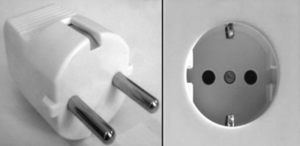
The electric power in Vienna is 220-240 volts, running at 50Hz, and the primary socket types are Schuko and Europlug (see figure below). Delegates are strongly encouraged to carry their own electrical adapters for use with laptops and other electrical appliances, as the Secretariat will not be able to provide them.
c) SIM cards for cellular phones
Local SIM cards that can be used with unlocked phones are available from any post office or news stand. A valid passport is required for purchase.
d) Post office, telephones and faxes
A post office on the first floor of the C-Building of the Vienna International Centre (ext. 4986) provides all regular postal services, including a fax service, from 8 a.m. to 6 p.m. Monday to Friday.
e) Restaurants and cafes
The cafeteria is located on the ground floor of the F-Building. It is open on weekdays from 7.30 a.m. to 10 a.m. for breakfast and from 11.30 a.m. to 2.30 p.m. for lunch. The coffee corner in the cafeteria is open from 8.30 a.m. to 3.30 p.m.
The coffee areas in the M-Building and the C-Building (C07) are open from 9 a.m. to 4.30 p.m. Monday to Friday. The coffee corner near to the plenary hall will be open from 8.30 a.m. to 6.30 p.m. daily.
The coffee corner in the C-Building (C04) (offering a new sandwich concept and premium coffee) is open from 9 a.m. to 4 p.m.
The cocktail lounge/bar is located in the F-building. It is open from 11.30 a.m. to 8 p.m. Monday to Thursday and from 11.30 a.m. to 9 p.m. on Friday.
The à la carte fine dining restaurant is located in the F-building (entrance through the cocktail lounge/bar). It is open from 11.30 a.m. to 2.30 p.m. (reservations are strongly recommended; please send requests by email to RestaurantVIC@eurest.at no later than 11.30 a.m. on the day that the booking is required).
Additional information, including the weekly cafeteria menu and the restaurant menu, can be found at the following link: http://www.eurest.at/unido/.
SPARC General Assemblies (2018 - 1996)
2018
1-5 October
SPARC 6th General Assembly, Kyoto, Japan
2014
12-17 January
SPARC 5th General Assembly, Queenstown, New Zealand
2008
31 August – 5 September
SPARC 4th General Assembly, Bologna, Italy
- Programme and Abstract Book;
- Report published in the SPARC Newsletter No. 32.
2004
01-06 August
SPARC 3rd General Assembly, Victoria, Canada
- Programme and Abstract Book;
- Report published in the SPARC Newsletter No. 24.
2000
06-10 November
SPARC 2nd General Assembly, Mar del Plata, Argentina
- Programme and Abstract Book;
- Report published in the SPARC Newsletter No. 16.
1996
02-06 December
SPARC 1st General Assembly, Melbourne, Australia
Report published in the SPARC Newsletter No. 8.
2019 - 2010
2019
04-06 December 2019
SPARC 27th SSG meeting, Boulder, CO, USA
22-25 October 2019
Atmospheric Circulation in a Changing Climate, Madrid, Spain
25-27 March 2019
CFC-11 Symposium, Vienna, Austria
2018
06-07 October 2018
SPARC 26th SSG Meeting, Kyoto, Japan
01-05 October 2018
SPARC 6th General Assembly, Kyoto, Japan
2017
01 December 2017
25 years of international SPARC research, Zurich, Switzerland
18-20 October 2017
Early Career Researchers (ECR) Symposium and WCRP/SPARC workshop on “WCRP Grand Challenges and Regional Climate Change”, Incheon, South Korea
02-05 September 2017
IUGG/WCRP-SPARC training school on stratosphere-troposphere interactions, Cape Town, South Africa
2016
31 October – 1 November
WCRP/SPARC workshop: “Challenges for Climate Science – Synergies between SPARC and the WCRP Grand Challenges, Berlin, Germany
2014
12-17 January
SPARC 5th General Assembly, Queenstown, New Zealand
2012
27-30 November
SPARC 20th SSG Meeting, Buenos Aires, Argentina
26-27 November
Regional SPARC Workshop, Buenos Aires, Argentina (circular)
09-12 October
4th International HEPPA Workshop in conjunction with SPARC/SOLARIS, Boulder CO, USA
16-20 July
WCRP 33rd Session of the Joint Scientific Committee, Beijing, China (by invitation)
25-29 June
SPARC Workshop on Brewer-Dobson Circulation, Grindelwald, Switzerland
See circular. See website as PDF. Find presentations.
11-13 June
9th SPARC Data Assimilation Workshop, Socorro, New Mexico, USA
21-24 Mayf
IGAC/SPARC Global Chemistry-Climate Modeling and Evaluation Workshop, Davos, Switzerland
See 1st announcement. See 2nd announcement.
2-4 April
WCRP/IASC Polar Climate Predictability Workshop, Toronto, Canada
22-24 February
SPARC Workshop on Stratospheric Sudden Warming and its Role in Weather and Climate Variations, Kyoto, Japan
See circular
06-10 February
SPARC 19th SSG Meeting, Zurich, Switzerland (by invitation)
Agenda Workshop
Agenda SSGl
2011
13-15 December
Data Initiative – review mtg., Toronto, Canada
29 November-1 December
6th Atmospheric Limb Workshop, Kyoto, Japan
20-22 June
SPARC Workshop on Data Assimilation, Brussels, Belgium
2-5 February
SPARC 18th SSG meeting, Pune India (see Introduction; Meeting agenda; Local Workshop agenda; IITM workshop website)
2010
06-07 December
Canadian-SPARC 5th Annual Workshop, Toronto, Canada
03-05 November
SPARC DynVar Workshop, Boulder, CO, USA
See Circular.
25-20 October
Seasonal to Multi-decadal Predictability of Polar Climate, Bergen, Norway
See Rational; Programme; List of Speakers; Organising Committee; List of poster presenters.
29 September-02 October
International Conference “Deltas in Times of Climate Change”, Rotterdam, The Netherlands
18-25 July
38th Scientific Assembly of the Committee on Space Research (COSPAR-10), Bremen, Germany
12-16 July
SCOSTEP 2010, Berlin, Germany
21-23 June
SPARC Data Assimilation Workshop, Met Office, Exeter, UK
See Programme: presentations available upon request.
10-12 March
SOLARIS Workshop, GFZ, Potsdam, Germany
22-26 February
Gravity Wave Activity Workshop, ISSI, Bern, Switzerland
2009 - 2005
2009
30 November-04 December
5th Workshop on Lidar Measurements in Latin America, Instituto Teconologico de Buenos Aires (ITBA), Buenos Aires, Argentina
07-08 December
Canadian-SPARC 4th Annual Workshop, Toronto, Canada
16-19 November
5th International Atmospheric LImb Conference and Workshop, Finnish Meteorological Institute (FMI), Helsinki, Finland
09-11 November
CCMVal Authors’ Meeting, Toledo Spain (by invitation)
See Agenda.
26-30 October
SPARC 17th SSG Meeting, Kyoto, Japan
See Programme.
19-22 October
The Extratropical UTLS: Observations, Concepts and Future Directions, NCAR, Boulder, CO, USA
14-26 September
Water Vapour in the Climate System, International Summer School, Corse, France
29-39 July
SPARC Data Assimilation Workshop, held in conjunction with the IAMAS meeting (MOCA-09), Montreal, Canada
See Rational; Programme.
08-09 July
SPARC Volcano Meeting, Zurich, Switzerland (by invitation)
01-03 June
SPARC CCMVal Workshop 2009, Toronto, Canada
See Circular; Rational; Programme; Abstracts; List of participants.
17-19 March
WAVAS Authors’ Meeting, Toronto, Canada
2008
15-19 December
2008 Fall AGU Meeting, San Francisco, CA, USA
24-25 November
Canadian-SPARC 3rd Annual Workshop, Toronto, Canada
05-10 November
ESF-FMSH Entre-Sciences International Conference on New Methodologies and Interdisciplinary Approaches in Global Change Research, Porquerolles, France
21-23 October
Ibero-American Workshop on Seasonal Prediction: The Modelling Science and its Contribution to Development, CIIFEN, Guayaquil, Ecuador
10-13 November
SPARC 16th SSG Meeting, Toronto, Canada (by invitation)
See Agenda; Participant List; Presentations available upon request.
07-12 September
10th IGAC 2008 Conference: Bridging the Scales in Atmospheric Chemistry – Local to Global, Annecy-le-Vieux, France
31 August-05 September
SPARC 4th General Assembly, Bologna, Italy
13-20 July
37th Scientific Assembly of the Committee on Space Research and Associated Events (COSPAR 2008) – 50th Anniversary Assembly, Montreal, Canada
08-11 July
PAGES 3rd Open Science Conference, Corvallis, OR, USA
08-11 July
SCAR/IASC IPY Open Science Conference and Polar Research: Arctic and Antarctic Perspectives in the International Polar Year, St. Petersburg, Russia
06-10 July
Global Conference on Global Warming 2008, Istanbul, Turkey
29 June-05 July
Quadrennial Ozone Symposium 2008, Tromso, Norway
17-19 June
Workshop on the Role of Halogen Chemistry in Polar Stratospheric Ozone Depletion, Cambridge, UK
17-23 May
Summer school on Dynamics, long-term Memory, and Trends in the Climate System, organized by Canadian-SPARC, Banff, Alberta, Canada
27-28 March
SPARC DynVar Workshop, Toronto, Canada
See Circular.
2007
10-14 December
AGU meeting, San Francisco, CA, USA
03-04 December
Canadian-SPARC 2nd Annual Workshop, Toronto, Canada
05-09 November
SPARC/SCOUT-03/NDACC/CNRS Reunion Island International Symposium: Tropical Stratosphere – Upper Troposphere, Reunion Island, France
29 October-02 November
4th Limb Workshop, Virginia Beach, VA, USA
24-28 September
Chapman Conference: The Role of the Stratosphere in Climate and Climate Change, Santorini, Greece
18-21 September
SPARC 15th SSG Meeting, Bremen, Germany (by invitation)
04-07 September
SPARC Data Assimilation Workshop in conjunction with SPARC-IPY Workshop, Toronto, Canada
See Programme; Abstracts; List of participants; Presentations available upon request.
29-31 August
Polar Dynamics: Monitoring, Understanding, and Prediction – Open Science Conference, Bergen, Norway
27-31 August
Second International Conference on Earth System Modelling, organized by SPARC, CLIVAR and WCRP, Hamburg, Germany
See Circular.
20-24 August
AMS 14th Conference on the Middle Atmosphere, Portland, Oregon, USA
02-13 July
IUGG XXIV Assembly: Earth, Our Changing Planet, Perugia, Italy
25-29 June
SPARC CCMVal Workshop 2007, Leeds, UK
12-15 June
International Workshop on Upper Tropospheric Humidity & Intercomparison Campaign of Water Vapour Measurement Techniques, Karlsruhe, Germany (by invitation)
04-08 June
Seasonal Prediction Experiment Workshop, Barcelona, Spain
22-25 May
AGU Joint Assembly, Acapulco, Mexico
12-13 April
TRENDS meeting, Washington DC, USA (by invitation)
26-30 March
WCRP 28th Session of the Joint Scientific Committee, Zanzibar, Tanzania (by invitation)
12-16 February
3rd WGNE Workshop on Systematic Errors in Climate and NWP Models, San Francisco, CA, USA
22-23 January
1st Workshop on WCRP/IGBP Atmospheric Chemistry and Climate Initiative, Geneva, Switzerland
24-29 January
AMS Annual Meeting, San Antonio, Texas, USA
2006
01-15 December
AGU Fall Meeting, San Francisco, CA, USA
15-17 November
2006 CLIVAR Workshop on Multidecadal to Centennial Global Climate Variability, Honolulu, Hawai’i, USA
See Agenda.
09-12 November
ESSP Open Science Conference, Beijing, China
09-12 October
SPARC 14th SSG Meeting, Boulder, CO, USA (by invitation)
See Agenda; List of participants.
04-06 October
First SOLARIS Meeting, Boulder, CO, USA
See Report.
02-04 October
SPARC Data Assimilation Workshop, ESTEC, Noordwijk, The Netherlands
See Programme; List of participants.
26-28 September
ADM-Aeolus Workshop, ESTEC, Noordwijk, The Netherlands
17-23 September
Joint IGAC/CACGP/SOLAS/WMO Symposium: Atmospheric Chemistry at the Interfaces, Cape Town, South Africa
16-23 July
36th COSPAR Scientific Assembly and Associated Events, Beijing, China
12-14 June
Modelling of Deep Convection and of Chemistry and their Roles in the Tropical Tropopause Layer, organised by SPARC/GEWEX/GCSS/IGAC, Victoria BC, Canada (by invitation)
See Circular; Programme.
29 May-01 June
Canadian Meteorological and Oceanographic Society – 40th CMOS Congress, Toronto, Ontario, Canada
23-26 May
AGU Joint Assembly, Baltimore, USA
06-11 March
WCRP 27th Session of the Joint Scientific Committee, Pune, India (by invitation)
07-11 January
Joint SPARC-IGAC Workshop: The Routes for Organics Oxidation in the Atmosphere and its Implications to the Atmosphere, Alpe d’Huez, France
2005
14-16 December
Joint COSMAS/UTLS Ozone Final Science Meeting, Cambridge, UK
10-12 November
2nd International Conference on Arctic Research Planning (ICARP II), Copenhagen, Denmark
17-22 October
ICSU 28th General Assembly, Beijing, China
07-19 October
CCMVal-2005 Chemistry-Climate workshop, Boulder, CO, USA
09-13 October
IHDP 6th Open Meeting, Bremen, Germany
03-15 October
Cargese International School, COST Action 723: Upper Troposphere-Lower Stratosphere, Cargese, Corsica, France
12-16 September
EMS 5th Annual Meeting, Utrecht, The Netherlands
12-15 September
SPARC Data Assimilation Workshop & SPARC Workshop on Stratospheric Winds, Banff, Canada
See Rational; Programme; List of Participants; Presentations available upon request.
22-26 August
IAG/IAPSO with IABO Joint Scientific Assembly, Cairns, Australia
02-11 August
IAMAS 9th Scientific Assembly, Beijing, China
18-29 July
IAGA 10th Scientific Assembly, Toulouse, France
11-15 July
3rd Workshop on Lidar Measurements in Latin America, Popayan, Colombia
See Rational.
20-24 June
5th International Scientific Conference on the Global Energy and Water Cycle Experiment (GEWEX), Orange County, California, USA
12-17 June
AMS Joint Conference between Middle Atmosphere, Atmospheric and Oceanic Fluid Dynamics and Climate Variability and Change, Cambridge, Massachusetts, USA
23-27 May
AGU Spring Meeting, New Orleans, Louisiana, USA
18-20 May
Joint SPARC/IGAC UTLS Workshop: Processes governing the chemical composition of the mid-latitude UTLS, Mainz, Germany
See Rational; List of Speakers; List of Participants.
12-13 May
SPARC Polar Stratospheric Clouds Assessment Meeting, Coolfont, DC, USA
09-14 May
SCOSTEP 11th International Symposium on Equatorial Aeronomy, Taipei, Taiwan, China
07-13 May
Global Chemistry for Climate (GCC) Project Summer School on Hierarchy of Models, Banff, Alberta, Canada
See Rational; Programme.
24-29 April
EGU Assembly, Vienna Austria
18-22 April
WMO 4th International Symposium on Assimilation of Observations in Meteorology and Oceanography, Prague, Czech Republic
12-18 March
First GRIPS Meeting, Toronto, Canada
03-04 March
Update of Temperature Trends, Reading, UK
09-13 January
AMS 85th Annual Meeting, 16th Conference on Climate Variability, 7th Conference on Atmospheric Chemistry, San Diego, CA, USA
05-07 January
Joint IGAC/NOAA/NASA Conference on the Indirect Effects of Aerosols on Climate, Manchester, UK
2004 - 1995
2004
12-25 September
14th National Summer School on Geophysical and Environmental Fluid Dynamics, Cambridge, UK
04-09 September
8th International Global Atmospheric Chemistry (IGAC) Conference, Christchurch, New Zealand
16-26 August
ESA Summer School on Earth System Monitoring and Modelling, ESRIN, Frascati, Italy
16-20 August
2004 Western Pacific Geophyiscs Meeting (AGU WPGM), Honolulu, Hawai’i, USA
09-12 August
SPARC 3rd General Assembly, Victoria BC, Canada
18-25 July
COSPAR 35th Scientific Assembly, Paris, France
06-08 July
UTLS 6th Ozone Science Meeting, Lancaster, UK
09-14 June
3rd Workshop on Long-term Trends in the Atmosphere, Sozopol, Bulgaria
01-08 June
Quadrennial Ozone Symposium “Kos 2004”, Kos, Greece
24-28 May
2nd Latin-American Congress on Ultraviolet Radiation Measurements and Biological Effects in High Altitude Locations, La Paz, Bolivia
23-28 May
16th Rencontres de Blois “Challenges in the Climate Sciences”, Chateau de Blois, France
17-21 May
2004 CGU-AGU-SEG-EEGS Joint Assembly, Montreal, Canada
25-30 April
EGU 1st General Assembly, Nice, France
24-26 March
SPARC GRIPS Workshop, Bologna, Italy
15-20 March
34th Saas-Fee Advanced Course on The Sun, Solar Analogs and the Climate, Davos, Switzerland
29-30 January
International Workshop on Critical Evaluation of mm-/sub-mm-wave Spectroscopic Data for Atmospheric Observations, Mito, Ibaraki, Japan
10-14 January
AGU Chapman Conference on Gravity Waves Processes and Parameterisation, Kohala Coast, Hawai’i, USA
2003
18-29 December
Joint UTLS Ozone and CWVC Workshop on Aerosols in the Upper Troposphere-Lower Stratosphere (UTLS), Oxford, UK
09-11 December
Workshop on Observation, Transport Modelling and Climatology of the Southern Hemisphere Stratosphere, Buenos Aires, Argentina
17-19 November
Workshop on Process-oriented Validation of Coupled Chemistry-Climate Models, Garmisch-Patenkirchen, Germany
11-14 November
ACSYS Final Conference, Arctic and Antarctic Research Institute, St. Petersburg, Russia
04-05 November
SPARC Workshop on Understanding Seasonal Temperature Trends in the Stratosphere & Jim Angell 80th Birthday Symposium, Silver Spring, Maryland, USA
22-25 September
SPARC 11th SSG Meeting, Frankfurt, Germany
15-19 September
International Conference on Earth System Modelling, MPI, Hamburg, Germany
15-18 September
3rd IAGA Workshop on Solar Forcing of the Middle Atmosphere, IAP, Prague, Czech Republic
08-19 September
13th National Summer School on Geophysical and Environmental Fluid Dynamics, Cambridge, UK
01-05 September
Royal Meteorological Society’s Biennial Scientific Meeting, Norwich, UK
29 August
The Split Ozone Hole of 2002: A Meeting of the Atmospheric Chemistry Special Interest Group of the Royal Meteorological Society in association with the Centre for Atmospheric Science, University of Cambridge, Cambridge, UK
18-29 August
1st ENVISAT Data Assimilation Summer School, ESA/ESRIN, Frascati, Italy
07-13 August
One-Week Summer School on Global Chemistry and Climate of the Troposphere and Lower Stratosphere, Montreal, Canada
13-18 July
Gordon Research Conference on Solar Radiation and Climate, New London, NH, USA
30 June-11 July
IUGG XXII General Assembly, Sapporo, Japan
23-26 June
Modelling and Assimilation for the Stratosphere and Tropopause, ECMWF, Reading, UK
See Programme; List of Participants.
04-06 June
SPARC/ASSETT Data Assimilation Workshop, Florence, Italy
See Programme; List of Participants.
14-16 May
Workshop on Tropical Meteorology and Chemistry, DLR, Oberpfaffenhofen, Germany
29 April-02 May
Workshop on the Role of the Stratosphere in Tropospheric Climate, Whistler BC, Canada
06-11 April
EGS/AGU/EUG Joint Assembly, Nice, France
02-06 April
SPARC-IGAC Joint Meeting, Giens, France
17-21 March
WCRP 24th Session of the Joint Scientific Committee, Reading, UK
04-07 March
SPARC GRIPS Workshop, AGU HQ, Washington DC, USA
24-28 February
Workshop about Lidar Measurements in Latin America, Camagüey, Cuba
09-13 February
AMS 83rd Annual Meeting, Long Beach, CA, USA
2002
03-05 December
Workshop about DAWEX (Darwin Area Wave Experiment) Results, Honolulu, Hawai’i, USA (by invitation)
25-29 November
Colloque CNFCG-CNES: Regards croisès sur les Changements Globaux, Arles, France
18-21 November
SPARC 10th SSG Meeting, Kyoto, Japan
12-15 November
International Symposium on Stratospheric Variations and Climate, Fukuoka, Japan
04-08 November
AMS 12th Conference on the Middle Atmosphere, San Antonio, Texas, USA
10-19 October
COSPAR 34th Scientific Assembly and the 2nd World Space Congress, Houston, Texas, USA
18-25 September
Atmospheric Chemistry in the Earth System: from Regional Pollution to Global Change, Crete, Greece
16-17 September
VORCORE/STRATEOLE Workshop, CNES HQ, Paris, France
02-06 September
6th European Symposium on Stratospheric Ozone, Göteborg, Sweden
08-11 July
UTLS 5th Ozone Science Meeting, Bristol, UK
12-14 June
7th Biennial HITRAN Database Conference, Massachusetts, USA
27-30 May
GAW Workshop for WMO Region VI (Europe) on Status and Trends of Global Atmosphere Watch with particular emphasis on the situation and needs of WMO Region VI, Riga, Latvia
19 May-01 June
NATO Advanced Study Institute (NASI) on Data Assimilation for the Earth Sciences, Acquafredda di Maratea, Italy
13-16 May
276th WE-Heraeus-Seminar on Trends in the Upper Atmosphere (by invitation), Külungsborn, Germany
22-26 April
EGS XXVII General Assembly, Nice, France
08-12 April
29th International Symposium on Remote Sensing of Environment (ISRSE): Information for Sustainability and Development, Buenos Aires, Argentina
18-22 March
International Symposium on Equatorial Processes Including Coupling (EPIC), Kyoto, Japan
04-06 March
Arctic Ozone Loss Workshop, Potsdam, Germany
2001
17-19 December
Transport and Chemistry in the UTLS Region Workshop Programme, Cambridge, UK
10-14 December
AGU 2001 Fall Meeting, San Francisco, CA, USA
04-07 December
SPARC 9th Session of the SSSG, Honolulu, Hawai’i, USA
24-27 September
Network for the Detection of Stratospheric Change: NDSC 2001 Symposium, Arcachon, France
25 September-05 October
School on the Physics of the Equatorial Atmosphere, Trieste, Italy
10-14 September
GEWEX 4th International Conference, IPSL, Paris, France
19 August-01 September
Cargese International School, Cargèse, Corse, France
20-24 August
Workshop on Atmospheric Chemistry and Climate Interaction during the Climate Conference 2001, Utrecht, The Netherlands
19-31 August
IAGA-IASPEI 2001 Joint Scientific Assembly, Hanoi, Vietnam
16-20 July
Detecting Environmental Change: Science and Society, London, UK
10-19 July
IAMAS General Assembly, Innsbrück, Austria
10-13 July
Global Change Open Science Conference, Amsterdam, The Netherlands
08-21 July
WMO-GAW European Dobson Spectrophotometer Intercomparison, Hohenpeissenberg, Germany
02-06 July
2nd Workshop on Long-term Changes and Trends in the Atmosphere, organised by IAGA-ICMA/IAMAS and PSMOS/SCOSTEP, Prague, Czech Republic
17-21 April
Tropopause Workshop, Bad-Toelz, Germany
25-30 March
EGS XXVI General Assembly, Nice France
19-22 March
Workshop on Nitrogen Oxides in the Lower Stratosphere-Upper Troposphere (UTLS), Heidelberg, Germany
19-22 March
SPARC-IOC Preparation Meeting of the Next Ozone Assessment, Maryland, USA
06-08 March
Lidar Measurements in Latin America Workshop, Camagüey, Cuba
21 February-01 March
SPARC GRIPS Workshop, Hamburg, Germany
14-19 January
AMS 81st Annual Meeting: Millennium Symposium on Atmospheric Chemistry – Past, Present and Future of Atmospheric Chemistry Climate Variability, the Oceans and Social Impacts, 12th Symposium on Global Change Studies, 11th Symposium on Meteorological Observations and Instrumentation, Albuquerque, New Mexico, USA
2000
15-19 December
AGU 2000 Fall Meeting, San Francisco, CA, USA
11-15 December
12th Meeting of the Parties to the Montreal Protocol, Ouagadougou, Burkina Faso
27 November-01 December
ISARS2000: 10th International Symposium on Acoustic Remote Sensing, Auckland, New Zealand
06-10 November
SPARC 2nd General Assembly (SPARC 2000), Mar del Plata, Argentina
24-26 October
North American Research Strategy for Tropospheric Ozone (NARSTO) Technical Conference on Aerosol Science: Tropospheric Aerosols, Queretaro, Mexico
02-06 October
First S-Ramp Conference, Sapporo, Japan
02-06 October
12th Meeting of the Parties of the Montreal Protocol, Ouagadougou, Burkina Faso
25-29 September
Conference on Non-linear Phenomena in Global Climate Dynamics, Trieste, Italy
25-29 September
Euro-Conference on the Solar Cycle and Terrestrial Climate, Santa Cruz de Tenerife, Spain
22-29 August
Meeting of the UNEP Environmental Effects Assessment Panel, Abisko, Sweden
24-29 July
International Radiation Symposium (IRS), St. Petersburg, Russia
23-27 July
16th International Symposium on Gas Kinetics, Cambridge, UK
16-23 July
COSPARC 33rd Scientific Assembly, Warsaw, Poland
10-14 July
Meteorology at the Millennium, Cambridge, UK
10-14 July
20th International Laser Radar Conference (ILRC), Vichy, France
03-08 July
XXIX Quadrennial Ozone Symposium, Hokkaido University, Sapporo, Japan
14-15 June
20th EARSeL Symposium on Remote Sensing in the 21st Century: A Decade of Trans-European Remote Sensing Cooperation, Dresden, Germany
30 May-03 June
AGU Spring Meeting 2000, Washington, DC, USA
29 May-16 June
Chemistry-Climate Interactions: Summer Colloquium on the Physics of Weather and Climate, Trieste, Italy
08-11 May
12th Conference on Applied Meteorology & 15th Conference on Probability and Statistics in the Atmospheric Science, Asheville, North Carolina, USA
25-29 April
EGS’ 2000 Session Reports, Nice, France
13-17 March
Report on the WCRP Joint Scientific Committee 2000 Meeting, Tokyo, Japan
1999
13-15 December
Brewer-Dobson Workshop, Oxford, UK
12-15 October
Chapman Water Vapour Conference, Potomac, USA
27 September-01 October
Report on the 5th European Ozone Symposium, St-Jean-de-Luz, France
18-30 July
IUGG Birmingham Symposium Reports, Birmingham, UK
15-24 May
NATO ASI on Chemistry and Radiation Changes in the O3 Layer
19-23 April
EGS 1999 Session Reports, The Hague, The Netherlands
22-25 March
SPARC GRIPS ’99 Workshop Report, Reading, UK
15-20 March
WCRP Joint Scientific Committee meeting report, Kiel, Germany
16-19 February
International Workshop on Trends in the Atmosphere, Pune, India
1998
07-09 December
Workshop on Small Organic Peroxy Radicals, Paris, France
24-26 November
Seminar on Stratosphere-Troposphere Interactions, Cochin, India
08-11 November
European Workshop on Mesoscale Processes in the Stratosphere, Bad Tölz, Germany
12-19 July
COSPAR 32nd Scientific Assembly, Nagoya, Japan
29 June-02 July
European Conference on Atmospheric UV Radiation (ECUV), Helsinki, Finland
20-24 April
EGS 1998 General Assembly, Nice, France
16-20 March
WCRP Joint Scientific Committee meeting, Cape Town, South Africa
09-12 March
SPARC QBO Workshop, La Jolla, CA, USA
03-06 March
SPARC 3rd GRIPS Workshop, NAS GSFC, Greenbelt, Maryland, USA
1997
20-22 October
Workshop on Stratospheric Change, Tsukuba, Japan
September
4th European Symposium on Stratospheric Ozone Research, Schliersee, Germany
26-28 August
WCRP Conference & SPARC Report at the Conference, Geneva, Switzerland
18-21 August
2nd IAGA/IAMAS Workshop on Solar Activity Forcing of the Middle Atmosphere, Prague, Czech Republic
14 August
Session 2.18 of the IAGA/ICMA Symposium, Uppsala, Sweden
20-22 May
IGAC/SPARC/GAW Conference, Toronto, Canada
17-22 March
WCRP Joint Scientific Committee meeting, Toronto, Canada
03-06 March
SPARC 2nd GRIPS Workshop, Berlin, Germany
1996
21-23 October
International Workshop on Modelling Heterogeneous Chemistry of the Lower Stratosphere-Upper Troposphere (UTLS), Strasbourg, France
15-18 October
International Meeting on the Impact of Aircraft Emissions upon the Atmosphere, Paris, France
09-10 September
Workshop on SPARC Reference Climatology, Port Jefferson, New York
19-24 August
International Radiation Commission (IRC) Symposium, Fairbanks, Alaska, USA
19-20 July
COSPAR Session A1.1 on the Middle Atmosphere, Birmingham, UK
08-11 July
SPARC-IOC Workshop on Trends in the Vertical Distribution of Ozone, Haute Provence, France
06-10 May
EGS Assembly, The Hague, The Netherlands
14-19 April
Symposium on the Global Atmospheric Effects of Aviation, Virginia Beach, USA
21-25 April
Reports form EGS General Assembly, Vienna, Austria
01-05 April
NATO Advanced Research Workshop on Gravity Wave Processes and their Parameterisation in Global Climate Models, Santa Fe, New Mexico, USA
11-16 March
Report of the WCRP Joint Scientific Committee, Toulouse, France
04-07 March
SPARC 1st GRIPS Workshop, Victoria, Canada
1995
18-19 December
STTA Meeting, Berlin, Germany
02-11 October
NATO-ASI on UV-B Radiation, Halkidiki, Greece
18-22 September3rd European Symposium on Polar Stratospheric Ozone Research, Schliersee, Germany
05-15 September
NATO Advanced Study Institute (NASI) on the Stratosphere and its Role in Climate, Val Morin, Quèbec, Canada
02-14 July
IUGG General Assembly with The Middle Atmospheric Science Symposium, Boulder, CO, USA
13-15 June
SPARC Stratosphere-Troposphere Exchange Workshop, Pointe-de-Lac, Quèbec, Canada