
A-RIP – APARC Reanalysis Intercomparison Project
Coordinating Experts Driving the Project
Activity Leads
Jonathon Wright
Tsinghua University, China
jswright@tsinghua.edu.cn
Gloria Manney
NorthWest Research Associates, USA
(also at New Mexico Institute of Mining and Technology)
manney@nwra.com
Kris Wargan
NASA GSFC Global Modeling and Assimilation Office, USA
(also at Science Systems and Applications Inc.)
krzysztof.wargan-1@nasa.gov
Beatriz Monge-Sanz
University of Oxford, UK
beatriz.monge-sanz@physics.ox.ac.uk

Guidance from Key Scientific Leaders
Steering Committee
- Blanca Ayarzagüena
Universidad Complutense de Madrid, Spain - Sean Davis
NOAA Chemical Sciences Laboratory, USA - Mohamadou Diallo
Forschungszentrum Jülich GmbH, ICE-4, Germany - Masatomo Fujiwara
Hokkaido University, Japan - Yayoi Harada
Japan Meteorological Agency, Tsukuba, Japan - V. Lynn Harvey
Laboratory for Atmospheric and Space Physics, USA - K. Emma Knowland
NASA Global Modeling and Assimilation Office, USA
(also at Morgan State University) - Patrick Martineau
Japan Agency for Marine-Earth Science Technology (JAMSTEC), Japan - Felix Ploeger
Forschungszentrum Jülich GmbH, ICE-4, Germany
Overview of the Project’s Objectives and Scope
Activity Description
The APARC community has long used reanalysis and analysis datasets to understand atmospheric processes and variability in the troposphere and stratosphere, as well as to validate chemistry-climate models. With the increasing availability of global reanalysis datasets, we are continuing a coordinated activity to compare reanalysis datasets for diagnostics of interest to the APARC community. The objectives of this activity are to understand the causes of differences among reanalyses, to use the results to provide guidance on appropriate usage of reanalysis products in scientific studies, and to support future improvements in reanalysis products through these activities.
The APARC Reanalysis Intercomparison Project (A-RIP) involves close co-operation between reanalysis centres and scientists from APARC and other groups. We host community workshops, organize sessions in international conferences, and are planning a webinar series highlighting papers published in our special issues. The S-RIP Report in the SPARC report series was published in January 2022 (see below).
Overview of the Project’s Objectives and Scope
Activity Description
The APARC community has long used reanalysis and analysis datasets to understand atmospheric processes and variability in the troposphere and stratosphere, as well as to validate chemistry-climate models. With the increasing availability of global reanalysis datasets, we are continuing a coordinated activity to compare reanalysis datasets for diagnostics of interest to the APARC community. The objectives of this activity are to understand the causes of differences among reanalyses, to use the results to provide guidance on appropriate usage of reanalysis products in scientific studies, and to support future improvements in reanalysis products through these activities.
The APARC Reanalysis Intercomparison Project (A-RIP) involves close co-operation between reanalysis centres and scientists from APARC and other groups. We host community workshops, organize sessions in international conferences, and are planning a webinar series highlighting papers published in our special issues. The S-RIP Report in the SPARC report series was published in January 2022 (see below).
Key Insights from Research Outcomes
Published Results
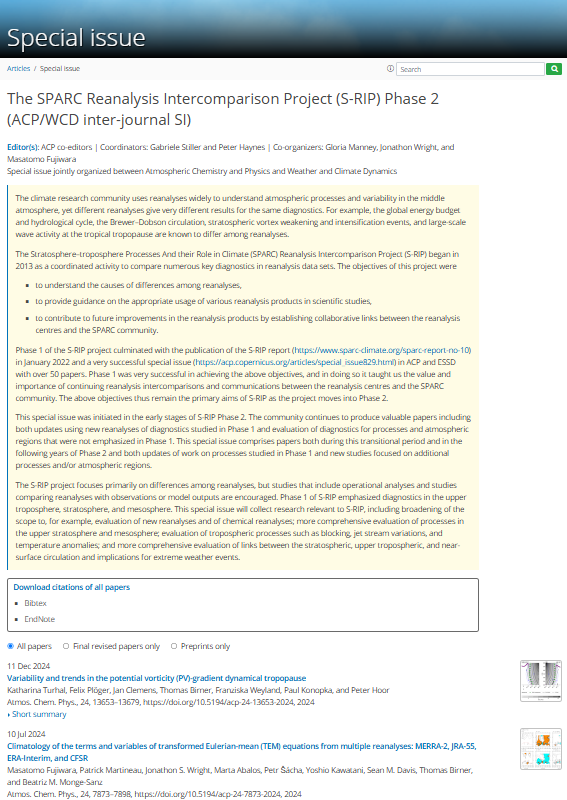
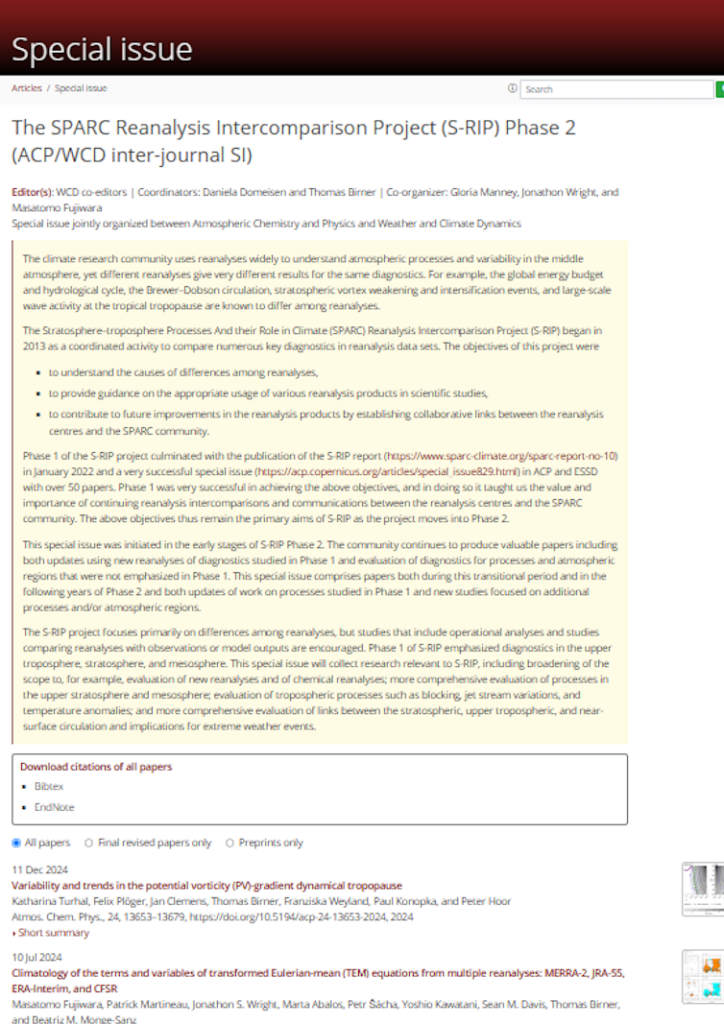
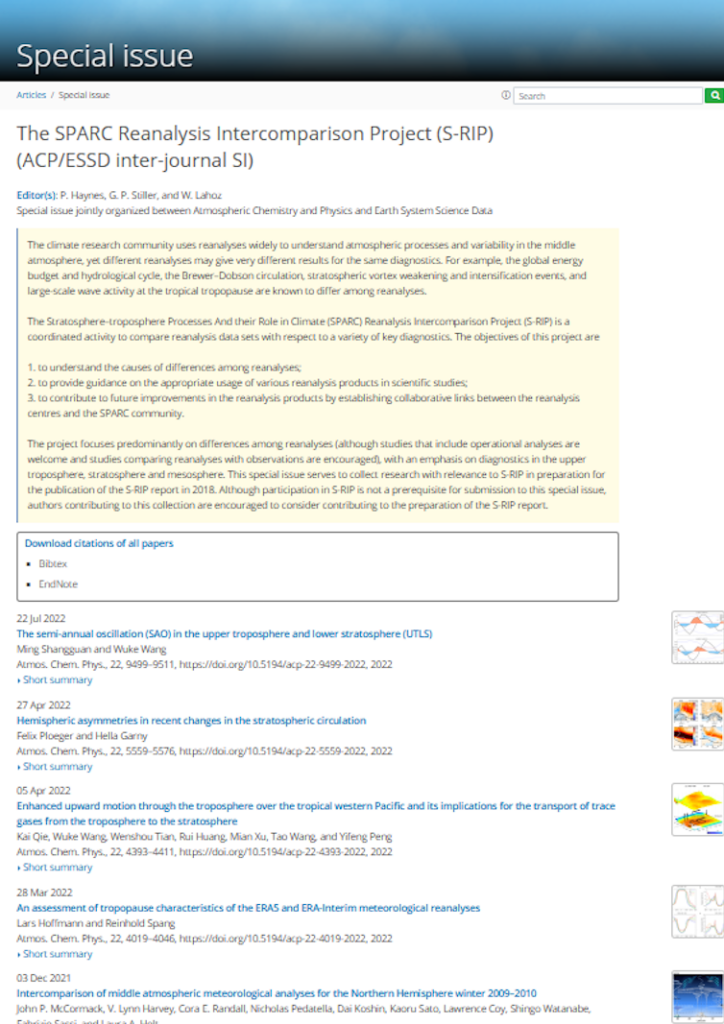
Just click on the pictures to read the reports.

Peer-Reviewed Contributions to Climate Science
Journal Publications
Fujiwara, M. et al., 2017: Introduction to the SPARC Reanalysis Intercomparison Project (S-RIP) and overview of the reanalysis systems. Atmos. Chem. Phys. 17, 1417-1452, doi: 10.5194/acp-17-1417-2017.
Long, C. S. et al., 2017: Climatology and interannual variability of dynamic variables in multiple reanalyses evaluated by the SPARC Reanalysis Intercomparison Project (S-RIP). Atmos. Chem. Phys. 17, 14593-14629, doi: 10.5194/acp-17-14593-2017.
Davis, S. M. et al., 2017: Assessment of upper tropospheric and stratospheric water vapour and ozone in reanalyses as part of S-RIP. Atmos. Chem. Phys. 17, 12743-12778, doi: 10.5194/acp-17-12743-2017.
See also: https://s-rip.github.io

Be Part of the Solution
Join the Climate Conversation
Collaborate with leading experts, explore groundbreaking research, and contribute to shaping a sustainable future. Together, we can make a difference.

Latest Developments and Ongoing Efforts
SPARC Activity Updates
SPARC Newsletter, No.60 (2023) p. 12–16: Planning and Proposal for Phase 2 of the SPARC-Reanalysis Intercomparison Project (S-RIP), by J.S. Wright, G. Manney, and M. Fujiwara.
SPARC Newsletter, No.58 (2022) p. 12–13: S-RIP Final Report Published, by M. Fujiwara, G. Manney, L. Gray, and J.S. Wright.
SPARC Newsletter, No.50 (2018) p. 26–29: The 2017 S-RIP workshop and the 13th SPARC data assimilation workshop, by J. McCormack, M. Fujiwara, Q. Errera, L. Gray, G. Manney, B. Monge-Sanz, and R. Dragani
SPARC Newsletter, No.48 (2017), p. 41–44: The 12th SPARC Data Assimilation Workshop and 2016 S-RIP Workshop, by M. Fujiwara, Q. Errera, L. J. Gray, G. L. Manney, J. McCormack, and J. Anstey
SPARC Newsletter No. 47 (2016), p. 12: The 2015 SPARC Reanalysis Intercomparison Project (S-RIP) workshop and the 11th SPARC data assimilation workshop, by Q. Errera, M. Fujiwara, and B. Legras
SPARC Newsletter No. 44 (2015), p. 31: Report on the 10th SPARC Data Assimilation Workshop and the 2014 SPARC Reanalysis Intercomparison Project (S-RIP) workshop in Washington DC, USA, by Q. Errera, M. Fujiwara, C. Long, and D. Jackson.
SPARC Newsletter No. 41 (2013), p. 52: SPARC Reanalysis Intercomparison Project (S-RIP) Planning Meeting, 29 April-1 May 2013, Exceter, UK, by M. Fujiwara and D. Jackson
SPARC Newsletter No. 38 (2012), p. 14: A proposal of the SPARC Reanalysis/Analysis Intercomparison Project, by M. Fujiwara, S. Polavarapu, and D. Jackson
Explore Detailed Resources and Updates
Website for Further Information
For a more comprehensive look into the project, its activities, and its ongoing contributions to atmospheric and climate science, visit the dedicated S-RIP website at s-rip.github.io. This platform provides detailed information on the project’s objectives, updates on recent developments, and access to an extensive library of publications and resources. Whether you’re interested in the latest research findings, reports, or data, the S-RIP website offers a wealth of material to support your understanding of this critical initiative. Explore the site to stay informed and engaged with the project’s progress and achievements.